Frankfurt Schnitzel.
In Vienna, potato salad sits beside it. In Frankfurt, a small pot of green sauce.
That's the whole difference, and it changes everything: the breading stays dry and crisp, the sauce arrives cold, made with seven herbs, and with every bite the guest decides how much of it to take.
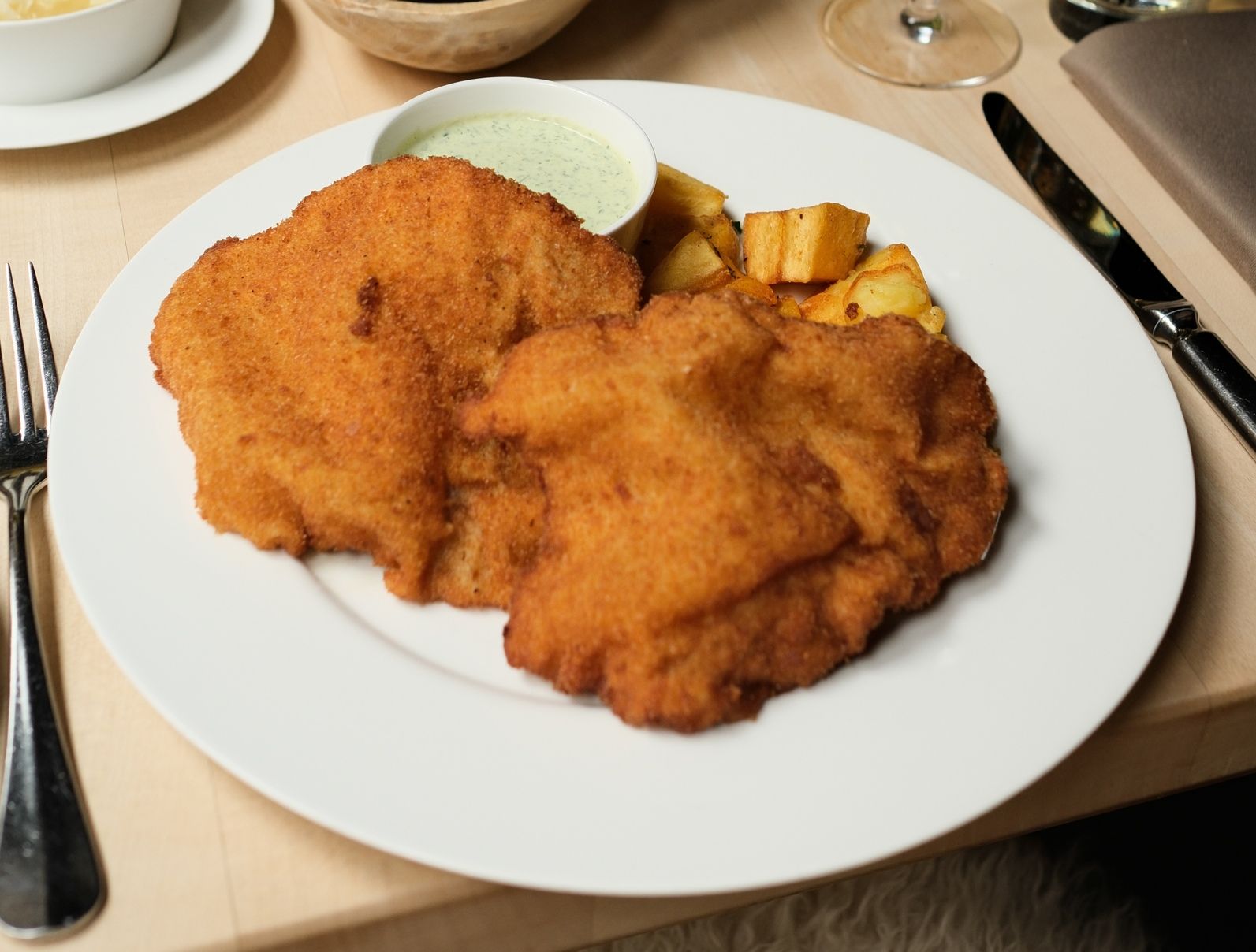
A Wiener with Frankfurt company.
The Frankfurt schnitzel isn't a recipe of its own. It's a decision. A breaded schnitzel, fried the way they do it in Vienna, and beside it the one thing that sits on every Frankfurt table on Maundy Thursday: green sauce. Together on one plate, they are the dish Frankfurters order when they're home, and visitors order when they want to know what the city tastes like.
Most taverns make it from pork. We make it from Hessian milk-fed veal, cut from the rump, just like the original in Vienna. The meat is paler, more tender, and needs less time in the pan. It costs more. The difference in every bite is worth it.
The sauce is never poured over the schnitzel. It stands in its little pot beside the plate, and the fried potatoes are there to soak it up. Put the sauce on the breading and you'll have a soft schnitzel within a minute. We tell every guest who asks.
Four steps,
no shortcuts.
The method comes from Alfred Friedrich, a two-Michelin-star chef who brought it to our kitchen in 2007. Girolamo Falco learned it at his side and has carried it out ever since, for every single schnitzel.
The CutVeal rump, nothing else
Our schnitzel comes from the rump of Hessian milk-fed veal. A lean, fine-grained cut that stays tender when sliced thin and doesn't fall apart.
The PressEven, not flattened
We don't pound our schnitzel. We press it. Pounding leaves the meat thinner in some places than in others; pressed, it's the same thickness everywhere. So it cooks evenly, and the breading lifts evenly all over.
The BreadingFlour, egg, breadcrumbs
In that order, and none of it from a packet. The crumbs come from Bäckerei Weller, made from real bread. You can taste it, and you can see it: the breading turns coarse and wavy, not smooth.
The SouffléIn clarified butter, in its own pan
The pans our schnitzel are fried in do nothing else. They were made for us in Belgium and are used for no other dish. The reason is the butter: it reaches exactly the same temperature in every pan. When the schnitzel is done, no clock tells you. The colour does. That's how Friedrich did it, and that's how Gino does it.
What guests ask.
Veal or pork?
Veal. Always. The original from Vienna is made from veal, and a Frankfurt schnitzel is nothing other than a Wiener with green sauce beside it. Why would we do it differently from the original.
Can I get extra green sauce?
Yes. A second pot, the sauce with another dish, more fried potatoes: everything on the menu can be combined. Just say so when you order, and the kitchen will follow.
What Gino drinks with it.
Höhl from the barrel, in the Bembel
Apple wine is Frankfurt in a glass: dry, tart, light. Exactly what a schnitzel from the butter wants. It cuts through the breading without getting in the way of the herbs in the sauce. If you eat schnitzel in Frankfurt, you drink apple wine with it.
Unfiltered Kellerbier, our house beer
Cloudy, mild, soft. It settles in beside the butter instead of fighting it, and the gentle yeast suits the breadcrumbs. If you prefer it crisp, take the Pils: its bitterness clears away the fat of the breading and makes the next bite fresh again.
Riesling from the Rheingau
A dry Riesling with good acidity does the same as the apple wine, only more elegantly: it lifts the veal, cuts the butter, lets the herbs stand. Our tip: the Riesling that the Künstler estate in Hochheim bottles especially for us, the Wirtshaus Edition.